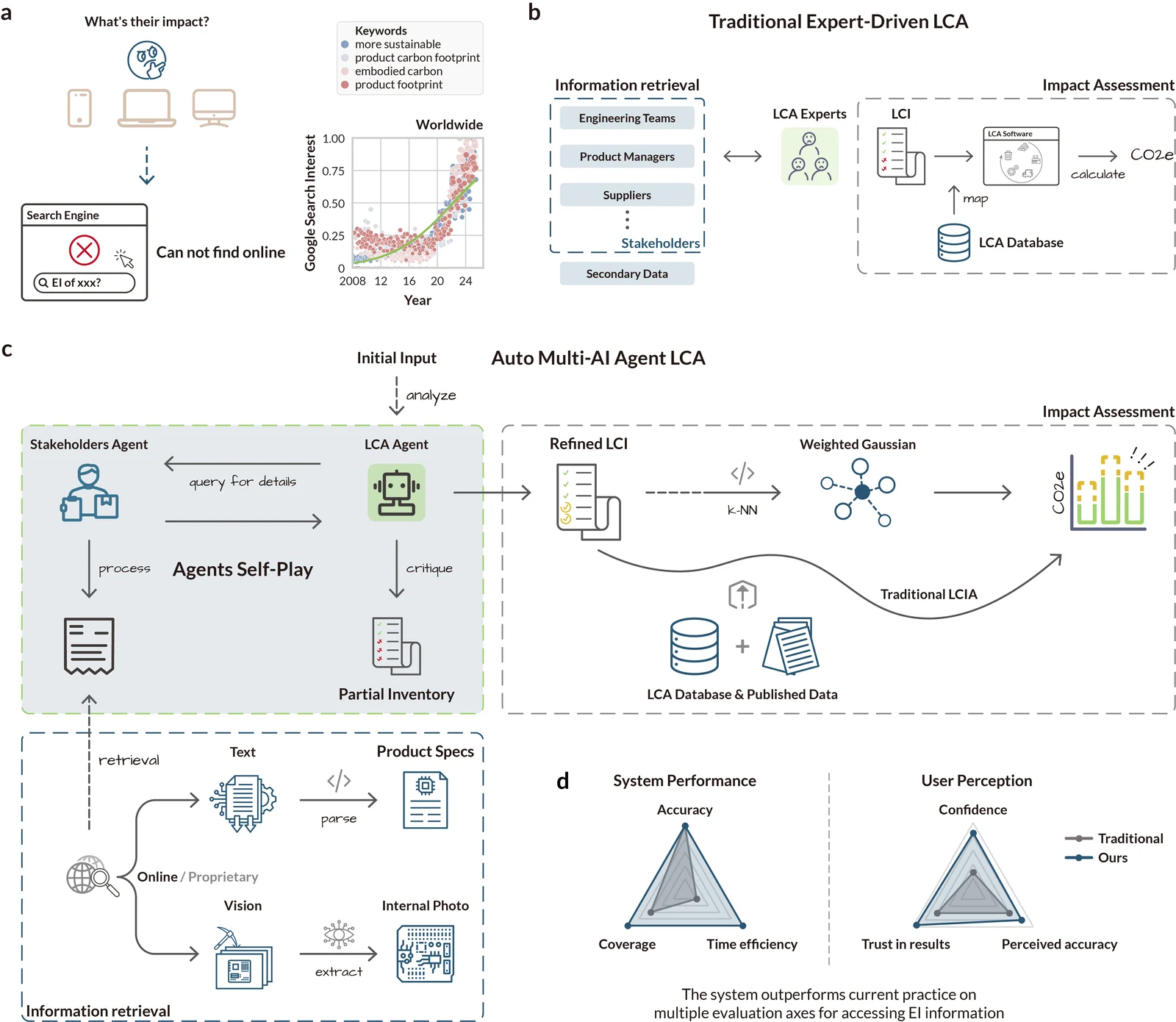
The system reduces life-cycle inventory data collection from weeks or months of expert time to under one minute, and estimates carbon footprints within 19% of expert LCAs using zero proprietary data.
Why this is hard
When you buy a laptop, phone, or monitor, its climate impact is not just the electricity it uses. It includes mining, manufacturing, shipping, use, repair, and end-of-life. Experts call this a life-cycle assessment, and doing it well often requires internal bills of materials, manufacturing details, and specialized databases.
That makes environmental information scarce exactly where consumers, designers, and product teams need it: early, quickly, and across many devices.
What the agents do
Our system mimics a small LCA team. One part gathers clues from public sources such as repair communities, regulatory databases, and product documentation. Another part organizes that evidence into a structured life-cycle inventory. A final estimator uses domain knowledge to compare unknown products and emission factors to similar known examples.
The important idea is not that AI replaces expert LCAs. It is that public evidence, computer vision, retrieval, and structured estimation can make sustainability assessment much more accessible when expert-grade proprietary data is unavailable.
Why it matters
Electronics are central to modern life, but their environmental impact is difficult to see. A fast, transparent estimate can help researchers compare products, designers reason about tradeoffs, and consumers ask better questions. It turns sustainability from a hidden spreadsheet into something closer to a usable interface.
Interactive Demo
A tiny tool the agents can trust
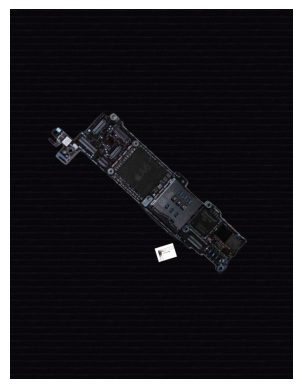
The full system coordinates many sources of evidence. One subcomponent is a specialized PCB segmentation model which lets the agent read unstructured online teardowns and FCC reports. Pick a preset image, or upload your own, and the detector will mark the circuit board pixels directly in your browser.
Loading PCB detector
Preparing the model in your browser.
The detector runs locally with ONNX Runtime Web; uploaded images stay in your browser.